

Table of Contents
ToggleHow Venture Capital Fuels Startup Growth
Every startup begins with a spark—an innovative idea that solves a problem. But to turn that spark into a roaring fire, you need fuel. In the business world, that fuel often comes in the form of Venture Capital (VC).
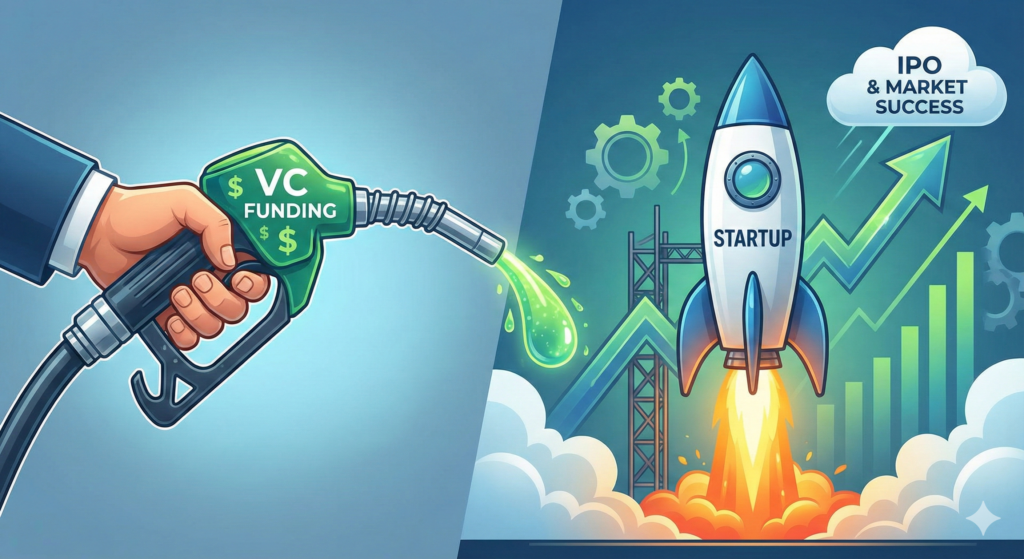
While many founders view VC simply as a bank transfer, its impact goes far beyond the dollar amount. Venture capital is “smart money,” designed not just to keep the lights on, but to strap a rocket engine to your company’s growth trajectory.
Here is a breakdown of how venture capital financing actually fuels startup success, referencing real-world dynamics and growth stages.
1. It Provides "Smart Money" and Strategic Guidance
The most distinct answer to “how venture capital helps startups” lies in the expertise that comes with the check. Unlike a traditional bank loan, VCs become active partners in your business.
Mentorship: Experienced VCs have seen hundreds of companies scale and fail. They often take a seat on your board, helping you avoid common pitfalls in product development or hiring.
Networking: A VC firm opens doors that are otherwise closed. whether it’s introductions to potential corporate partners, future investors, or top-tier talent that you couldn’t access alone.
2. It Accelerates Growth Through Defined Stages
Venture capital isn’t a lump sum; it is a structured lifecycle designed to fuel specific growth milestones.
Seed Stage: This is the ignition. Capital here is used to validate your idea, build a Minimum Viable Product (MVP), and find product-market fit.
Series A: Once the product works, Series A funding helps you optimize systems. It fuels the transition from a scrappy team to a structured organization.
Series B and Beyond: This is where the fuel is poured on the fire. Series B is strictly for scaling—expanding into new cities, countries, or demographics.
Example: Zepto, the quick-commerce giant, utilized this staged approach perfectly. By securing $60M in seed financing within months of launching, they didn’t just survive; they aggressively captured market share before competitors could react, eventually raising a massive Series C round to cement their status.
Read Our Article on Quick Commerce profitability
3. It Enables Aggressive Hiring and R&D
Bootstrapped companies often have to choose between hiring a new engineer or a marketing manager. Venture-backed startups can do both.
Access to significant capital allows startups to:
Hire Top Talent: You can offer competitive salaries to attract industry veterans who can professionalize your operations.
Innovate Faster: Funds can be poured into Research & Development (R&D) to improve the product, ensuring you stay ahead of the competition.
4. It Builds Credibility and Valuation
Securing funding from a reputable VC firm acts as a seal of approval. It signals to the market, customers, and the media that your business has high potential.
Valuation Boost: As you progress through rounds (Series A, B, C), your company’s valuation typically increases. This financial health makes it easier to acquire smaller companies or eventually launch an Initial Public Offering (IPO), providing an exit route for early investors and founders.
The Trade-Off: High Octane Comes with Pressure
While the benefits are immense, this fuel burns hot. Accepting venture capital means managing equity dilution—giving up ownership stakes with every round. It also introduces performance pressure; investors expect rapid returns, often pushing for aggressive growth targets that can be stressful to manage.
Conclusion
So, how does venture capital fuel startup growth? It provides the necessary capital to scale operations, the strategic network to open doors, and the credibility to dominate a market. For startups aiming to grow from a garage idea to a global enterprise like Razorpay or Zepto, venture capital is often the essential catalyst that makes it possible.