
Table of Contents
ToggleThe "Dashboard Fatigue" is Real
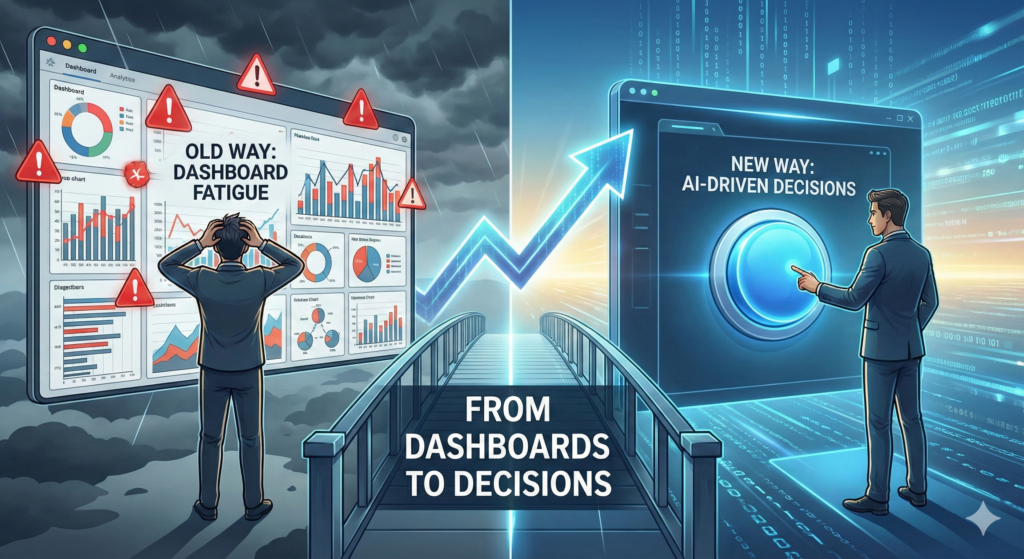
Let’s be honest. If you are a marketer or business owner today, you don’t have a data problem. You have a clarity problem.
You probably have ten different tabs open: Google Ads, Meta Business Suite, Analytics, Shopify, and maybe a few spreadsheets. You are staring at colorful charts, endless rows of numbers, and “vanity metrics.” But at the end of the day, you are still left asking the same stressful question:
“Okay, the data looks cool… but what do I actually do next to make more money?”
This is exactly where the industry is shifting. We are witnessing a massive evolution in how advertising intelligence is evolving. We are moving away from passive dashboards that just show you problems, to active, intelligent systems that tell you how to fix them.
If you want to stay ahead of the curve in 2026, you need to understand this shift from “Descriptive” to “Prescriptive” intelligence. Let’s dive in.
The Core Shift: From "What Happened?" to "Do This."
For the last decade, advertising intelligence was all about Descriptive Analytics. It was like a car’s rearview mirror—it showed you what had already happened. “Your CPC went up yesterday.” Great, thanks. But that doesn’t help me fix it now.
The future, as highlighted by pioneers like GrowthJockey and their Intellsys AdGPT system, is Prescriptive Intelligence.
Think of this as a GPS for your marketing. A GPS doesn’t just tell you “there is traffic ahead.” It instantly calculates: “Traffic ahead. Take the next right to save 15 minutes.”
Read Our Article on: Quick Commerce Profitability
Real-World Example: The "AdGPT" Revolution
New platforms are emerging that don’t just dump data on you; they act as a “Growth Architect.”
Unified Data: Instead of logging into 5 platforms, these systems pull data from Google, Meta, Amazon, and your CRM into one “brain.”
Root Cause Analysis: If your sales drop, the AI doesn’t just show a red arrow. It digs deep to tell you why—e.g., “Your creative fatigue on Facebook is driving up costs.”
Actionable Advice: It gives you a specific command: “Refresh the creative for Ad Set B to lower CAC by 15%.”
3 Major Trends Driving This Evolution
Beyond just smarter software, here is how the entire landscape of advertising intelligence is changing right now.
1. Trust Without the Middleman
Remember the days of needing a SQL expert to pull a report? Those are gone. The new standard is “Conversational AI.” You can now literally ask your analytics tool questions in plain English.
Old Way: Clicking through 10 filters to find last month’s ROAS.
New Way: Typing, “Hey, which creative had the best ROI in California last week?” and getting an instant answer.
2. The Rise of "Agentic" AI
We are moving from AI that recommends to AI that acts. In 2026, we will see more “AI Agents”—autonomous bots that can execute tasks with your permission.
Scenario: You set a rule that says, “If ROAS drops below 2.0, kill the ad.” The AI watches your campaigns 24/7. It hits the kill switch at 3 AM while you are sleeping, saving you thousands of dollars. It’s not just intelligence; it’s a digital employee.
Read Our Article on AI Agent Builders: n8n vs Zapier vs Make
3. Privacy-First Intelligence
With cookies disappearing and regulations tightening, “spying” on users is out. “Modeling” is in. Advertising intelligence is evolving to rely on First-Party Data (data you own) and advanced predictive modeling. The systems are getting smarter at guessing what users will do without needing to invade their privacy.
The "Venture-Scale" Advantage
One interesting insight from the reference material is how this tech is being built. It’s no longer just for massive corporations.
Tools are being trained on “venture data”—specific performance patterns from startups and high-growth companies. This means the AI understands the unique chaos of scaling a business. It knows that a drop in traffic for a startup is different from a drop in traffic for Coca-Cola, and it adjusts its advice accordingly.
Read Our Article on: How Venture Capital Helps Startups
Conclusion: Don't Just Watch the Data, Use It
The evolution of advertising intelligence is exciting because it gives power back to the human strategist.
When you stop spending 80% of your time pasting numbers into Excel, you get 80% of your time back to be creative, strategic, and human.
My advice? Stop settling for tools that just show you charts. Look for platforms that give you answers. The question isn’t “do you have data?” The question is, “is your data working for you, or are you working for your data?”
Read More Articles on: Technology and AI