


If you are a computer science student sitting for placements, you have likely lost sleep over the ultimate showdown: Projects vs. Data Structures & Algorithms (DSA).
It’s the classic dilemma. Should you spend your nights grinding LeetCode problems until you dream in dynamic programming? Or should you be building a full-stack application that solves a real-world problem?
The answer isn’t a simple “one is better than the other.” It depends entirely on where you want to work and how the hiring funnel works. Let’s break it down so you can prioritize your time.
Table of Contents
Toggle1. DSA - The Gatekeeper
Make no mistake: for most high-paying product-based companies (think MAANG and top-tier tech firms), DSA is the non-negotiable entry ticket.
The Filter: Recruiters receive thousands of applications. An Online Assessment (OA) based on DSA is the fastest way to filter candidates. If you can’t solve the problem, your amazing project might never be seen.
The logic: Companies use DSA to test your raw problem-solving ability and coding efficiency, not just your knowledge of a specific language.
The Reality Check: Mastering DSA is a marathon, not a sprint. It requires consistent, deep work. If you find yourself getting distracted or burning out during those long coding sessions, you might want to look into 7 science-backed ways to improve study focus. Learning how to learn is half the battle when tackling complex algorithms.
2. Projects - The Differentiator
If DSA gets your foot in the door, your Projects are what help you kick it open. Once you pass the coding round and sit in front of an interviewer, they rarely ask you to invert a binary tree on a whiteboard for 45 minutes straight. They want to talk about engineering.
Proof of Skill: Anyone can memorize an algorithm. Projects prove you can actually build software, debug messy code, and handle version control.
Conversation Control: A complex, unique project gives you something to talk about. It allows you to steer the interview toward your strengths (“Let me explain how I optimized the database queries in this app…”).
The Visibility Factor: Building a great project is only step one; step two is marketing it. You need to make sure recruiters and automated systems actually find your work. In today’s market, it is crucial to optimize your LinkedIn profile for AI recruiters so that your projects and skills get flagged by the algorithms before a human even reviews your resume.
How to Balance Both?
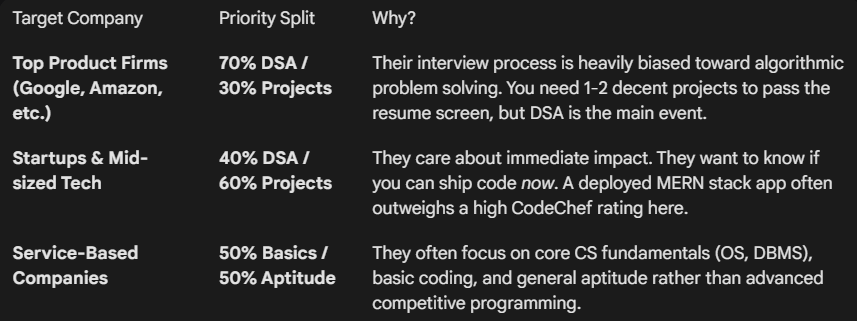
Top Product Firms (Google, Amazon, etc.) For these giants, the split is roughly 70% DSA and 30% Projects. Their interview process is heavily biased toward algorithmic problem solving. You generally need 1-2 decent projects just to pass the resume screening, but once you are in the room, DSA is the main event.
Startups & Mid-sized Tech Here, the dynamic flips to 40% DSA and 60% Projects. These companies care about immediate impact and want to know if you can ship code now. A deployed MERN stack app often outweighs a high CodeChef rating in this environment.
Service-Based Companies The focus here is usually 50% Basics and 50% Aptitude. They often prioritize core CS fundamentals (like OS and DBMS), basic coding skills, and general aptitude rather than advanced competitive programming.
Final Advice
Don’t fall into the trap of tutorial hell for projects or endlessly solving easy problems for DSA.
Do DSA daily: Even just 1 hour keeps the muscle memory alive.
Build one “Flagship” Project: Instead of 5 to-do lists, build one complex app with authentication, a database, and a real user interface.
Your placement success is a function of both. DSA gets you the interview; Projects get you the job.




Heard some buzz about kubet11tax. Jumped on to take a look and the site loads fast, which is a massive plus. Could use a little design touch ups, but overall not bad! Give it a go: kubet11tax
Yo! I checked out jii7777 and it’s alright. Solid, you know? It’s worth a look See for yourself right here: jii7777
Alright, just had a go at j88abcvip. I must say it is more complicated than other website, but not difficult. Check it out: j88abcvip
567gamelogin is where it’s at! Easy to navigate, tons of games, and I’ve actually won a few times. No complaints here. Get in the game: 567gamelogin
Rajabet’s been a solid choice for casino games and sports betting. I’ve had some lucky streaks there and the platform is easy to navigate. Plus, they seem to offer decent bonuses regularly. Give Rajabet a try if you’re looking for a reliable platform. rajabet
Heard about Soxo66vn from a friend. Seems legit with a decent selection of games and offers. Need to dive deeper but so far, it looks interesting. Will try it out this weekend. soxo66vn
Happybingoph! I like the name, and the bingo is actually pretty fun. Quick games and a decent community. If you like bingo, this might be your new jam. Check it out at happybingoph.
Yo, heard some buzz about this y555game. Is it any good? The site looks decent. Gonna check it out and see if it’s worth the hype. Find the link here: y555game
Heard f9game has got some new titles. Downloading some games now, hope they are good. If you want to check it out for yourself visit f9game