
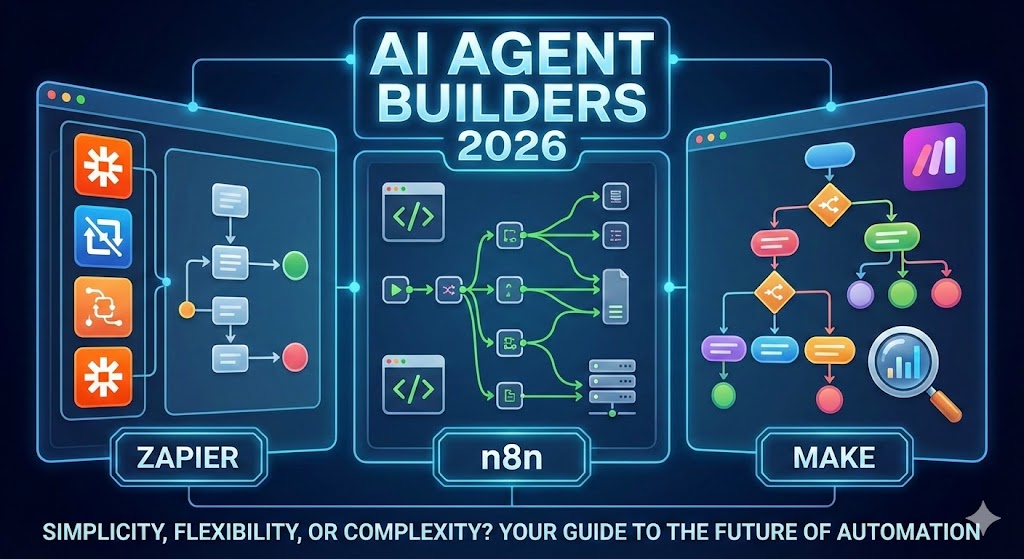

The era of simple, linear automation—”When X happens, do Y”—is officially behind us. In 2026, we aren’t just building automations; we are orchestrating intelligence. The rise of agentic workflows has fundamentally shifted the requirements for operations teams and citizen developers. We now need systems that can reason, loop, correct themselves, and handle massive context windows without breaking the bank.
As the “democratization of code” matures, three titans have segmented the market: Zapier, Make (formerly Integromat), and n8n.
If you are a solopreneur, a marketing ops lead, or a citizen developer, choosing the right platform is no longer just about convenience—it is a strategic decision regarding your business’s scalability and data privacy. In this guide, we dive deep into the n8n vs Zapier vs Make debate to help you select the premier no code AI agent builder for your needs.
The Landscape in 2026: From Automations to Agents
Before comparing features, we must acknowledge the shift in architecture. Traditional automation was a straight line. AI Agents, however, are circular. They require:
- Recursive Logic: The ability to loop until a result is satisfactory.
- Memory Management: Storing conversation history or vector embeddings.
- Cost Efficiency: “Per-task” pricing models (popularized by Zapier in the 2010s) become financially ruinous when a single AI agent executes 50 internal steps to answer one user query.
Let’s break down how the “Big Three” handle this new reality.
Zapier: The Entry Point for Speed and Simplicity
Zapier remains the household name in automation, and for good reason. In 2026, it continues to hold the crown for the largest integration library, boasting over 8,000 pre-built apps.
The “Speed to Value” Argument
If your goal is to set up a sales notification or cross-post content from LinkedIn to X (formerly Twitter) in under five minutes, Zapier is unbeatable. Its “Magic Studio” AI features have lowered the barrier to entry so significantly that a user with zero technical knowledge can describe a workflow and have it built instantly.
The Limitation: The “Zap Tax”
However, Zapier’s strength is also its weakness. It abstracts away so much complexity that it creates a “black box.” For AI agents that require granular control over API calls or complex looping, Zapier can feel restrictive. Furthermore, the pricing model—charging per “task”—is a major bottleneck for agentic workflows. If your AI agent needs to “think” (loop) 10 times to solve a problem, you are billed for 10 tasks.
Best For: Solopreneurs and Sales teams needing immediate, simple connections without maintenance.
Make: The Visual Architect for Logic Designers
If Zapier is a sketchbook, Make is a CAD program. Dominating the “visual thinker” market, Make’s bubble-logic interface allows users to visualize complex branching, error handling, and data manipulation in a way that mimics a flowchart.
The “Visual Complexity” Argument
Make shines when workflows are non-linear. In 2026, where AI agents often need to make “If/Then/Else” decisions based on sentiment analysis or data confidence scores, Make’s interface is superior. It allows you to drag and drop router modules that direct traffic visually, making it the preferred choice for Marketing Operations professionals who need to see the logic to understand it.
The Limitation: The Learning Curve
With great power comes a steeper learning curve. Understanding Make’s data structures (arrays vs. collections) and JSON parsing is necessary. It is a “low-code” tool disguised as “no-code.”
Best For: Ops Managers and Visual Architects building complex content engines or multi-step verification processes.
n8n: The Powerhouse for Sovereignty and Scale
In 2026, n8n has emerged as the clear favorite for technical marketers, developers, and privacy-focused organizations. Unlike its cloud-only competitors, n8n offers a fair-code model that allows for self-hosting.
The “Privacy First” & “Cost of Scale” Argument
Two factors make n8n the heavy hitter for AI agent building:
- Data Sovereignty: With GDPR and AI governance laws becoming stricter in Europe and globally, the ability to host n8n on your own servers means your customer data never leaves your infrastructure. This is a massive competitive advantage for enterprise compliance.
- Execution Pricing: n8n is often described as “1000 times more cost-efficient” for high-volume automations. Because it executes workflows based on server capacity (if self-hosted) rather than a “per-task” meter, you can run complex, looping AI agents thousands of times a day for a flat server cost, rather than a variable SaaS bill.
Best For: Developers, CTOs, and businesses prioritizing GDPR compliance and high-volume data processing.
Comparison: n8n vs zapier vs make
| Feature Category | Zapier | Make | n8n |
| Primary Persona | Non-technical Marketers / Beginners | Visual Architects / Logic Designers | Developers / Ops / Privacy-Focused |
| Cost Scaling | Expensive at volume (Per-task model) | Moderate (Per-operation model) | Highly Efficient (Per-workflow/Server cost) |
| Complexity Handling | Linear, rigid paths | Advanced branching & visual logic | Full API control, custom JS nodes |
| Data Sovereignty | Cloud-only (US Servers) | Cloud-managed | Self-hostable (GDPR Compliant) |
| AI Capabilities | Standard Integrations | Advanced Logical Handling | Custom Agent Orchestration & LangChain Support |
| Learning Curve | Low | Medium | High |
Deep Dive: Key Buying Factors
When choosing your no-code AI agent builder, consider these three critical dimensions.
1. The Cost of Looping (Agentic Workflows)
AI agents are iterative. They draft, critique, revise, and finalize.
- In Zapier, a revision loop that runs 5 times costs you 5 tasks. If you run this for 1,000 customers, your bill explodes.
- In n8n, if you are self-hosting, that same loop costs you a fraction of a cent in server CPU time. For businesses building automated customer support agents or research bots, n8n is the only economically viable option at scale.
2. The “Black Box” vs. Open Code
Visual builders are great until you hit a wall.
- Make allows for significant data manipulation, but you are still bound by their modules.
- n8n treats code as a first-class citizen. You can drop a JavaScript node anywhere in the flow to execute custom logic. This hybrid approach—visual when you want it, code when you need it—is why it is winning over the “Citizen Developer” market.
3. Data Sovereignty and Governance
In 2026, “Preemptive cybersecurity” is a major trend. Relying on third-party clouds to process sensitive PII (Personally Identifiable Information) via LLMs is a risk.
- Zapier and Make process data on their servers.
- n8n allows you to keep the processing local or within your private cloud, ensuring that sensitive data used in AI prompts isn’t exposed to the platform provider.
Recommendations: Which One is For You?
The “best” tool depends entirely on your strategic priorities.
Choose Zapier if:
- You have a generous budget and low technical skills.
- You need to connect standard SaaS apps (Gmail to Slack) quickly.
- Your workflows are linear (Trigger -> Action) and rarely loop.
Choose Make if:
- You are a visual thinker who needs to see the “flow” of data.
- You require complex logic (routers, filters, aggregators) but don’t want to write code.
- You are building content publishing engines or mid-complexity marketing ops.
Choose n8n if:
- Privacy is non-negotiable: You need to self-host for GDPR or security.
- Volume is high: You plan to run thousands of AI executions and want to avoid the “per-task” tax.
- You want full control: You are comfortable pasting a snippet of JavaScript to get exactly the result you need.
Conclusion
The market for the no-code AI agent builder has matured. We are no longer just “connecting glue”; we are building operating systems for our businesses.
While Zapier remains the king of accessibility and Make holds the throne for visual design, n8n is the defining platform of 2026 for those who are serious about building scalable, secure, and intelligent agentic workflows.
As you plan your automation stack for the coming year, ask yourself: Are you building a simple trigger, or are you building an agent? Your answer will determine the platform you need.
Ready to Future-Proof Your Operations?
Don’t let inefficient tooling slow down your AI adoption. Start by auditing your current workflows. If you find yourself spending more on “tasks” than software subscriptions, it might be time to look at self-hosted options.



VNL… not too familiar with it. Probably new, right? I’ll give it a look. Let’s check it out. More info on this page: vnl
Yo, 665betlogin! Giving this a shot. Hopefully, it pays out! Good luck to everyone using 665betlogin.
Pakgamelogin, comin’ through! Hope the games are fire! Check it out and let me know what you think at pakgamelogin.