

Table of Contents
ToggleFrom Cash Burn to Cash Flow: How Retailers Are Making Quick Commerce Profitable
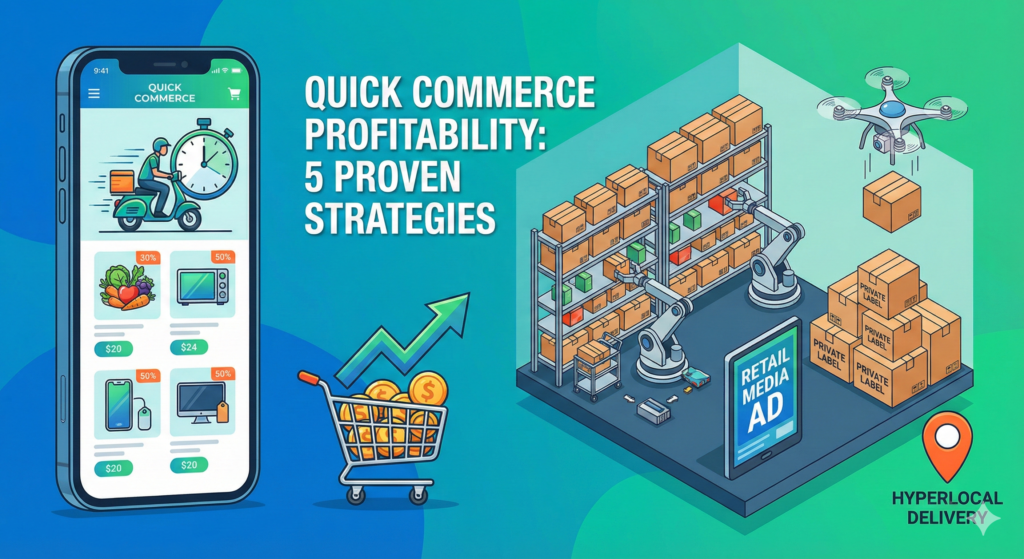
For years, “Quick Commerce” was synonymous with burning cash. The promise of 10-minute grocery delivery seemed like a consumer’s dream but a logistical nightmare for businesses. However, the narrative has shifted. In 2025, leading players like Blinkit, Zepto, and Instamart aren’t just surviving—they are cracking the code to profitability.
For retailers and Q-commerce operators, the game is no longer just about speed; it’s about unit economics.
Here are the five strategies that are transforming quick commerce from a loss-leading service into a profitable business model.
1. The "Retail Media" Goldmine
The biggest secret to Q-commerce profitability isn’t the delivery fee—it’s the digital shelf. Quick commerce apps have morphed into high-intent search engines.
Brands are willing to pay a premium to appear at the top of search results for terms like “milk” or “chips.” This advertising revenue (often called Retail Media Networks) has virtually zero marginal cost for the retailer but contributes significantly to the bottom line.
The Strategy: Retailers are monetizing their app interfaces by offering sponsored product listings, banner ads, and “checkout” cross-selling slots to FMCG brands.
2. Private Label Expansion
Selling third-party toothpaste yields razor-thin margins. Selling your own brand of toothpaste? That’s where the profit lies.
Major Q-commerce players are aggressively launching Private Labels (in-house brands) across categories like staples, snacks, and home essentials.
The Strategy: By sourcing directly from manufacturers and bypassing intermediaries, retailers can increase gross margins by 5-10%. Private labels also allow retailers to control inventory better and offer lower prices to consumers while keeping more profit.
3. Dark Store Density & AI Optimization
The “Dark Store” (a mini-warehouse closed to the public) is the heart of quick commerce. Profitability relies on ensuring these stores process orders with military precision.
Retailers are using AI to predict demand down to the hour. If data shows a spike in ice cream orders at 9 PM on Fridays, the AI ensures stock is moved to the front of the dark store before 8 PM to shave seconds off picking time.
The Strategy:
Micro-zoning: Placing dark stores every 2-3 km to reduce “last-mile” fuel costs.
Batching: Using algorithms to group multiple orders into a single delivery run, drastically lowering the delivery cost per order.
4. Diversifying Beyond Groceries (High AOV)
You cannot build a profitable business solely on delivering ₹20 packets of coriander. The solution is increasing the Average Order Value (AOV).
Q-commerce platforms have expanded into high-margin categories like electronics, beauty products, gifting, and even apparel.
The Strategy: Retailers are using the “impulse buy” nature of quick commerce to sell headphones, chargers, or premium cosmetics. Delivering an iPhone in 10 minutes costs roughly the same as delivering a bag of potatoes, but the profit margin is exponentially higher.
5. Dynamic Pricing and Memberships
Surge pricing is no longer just for ride-sharing. Quick commerce retailers are increasingly using dynamic pricing models during peak hours (e.g., rain, match days, or festivals) to manage demand and offset higher delivery costs.
Furthermore, Subscription Models (like Swiggy One or Zepto Pass) lock customers into the ecosystem.
- The Strategy: While members may get free delivery, data shows they order 30-40% more frequently than non-members. This volume compensates for the waived delivery fees, turning high-frequency users into profitable lifetime customers.
Read more Articles on Business Category!



IPLBetApp, now we’re talking! If you’re into cricket, this could be your thing. Loads to see! Check it out, mate: iplbetapp
SX66app is easy to install. I would recommend it because it doesn’t lag. Here’s the link sx66app